It appears that your cart is currently empty!

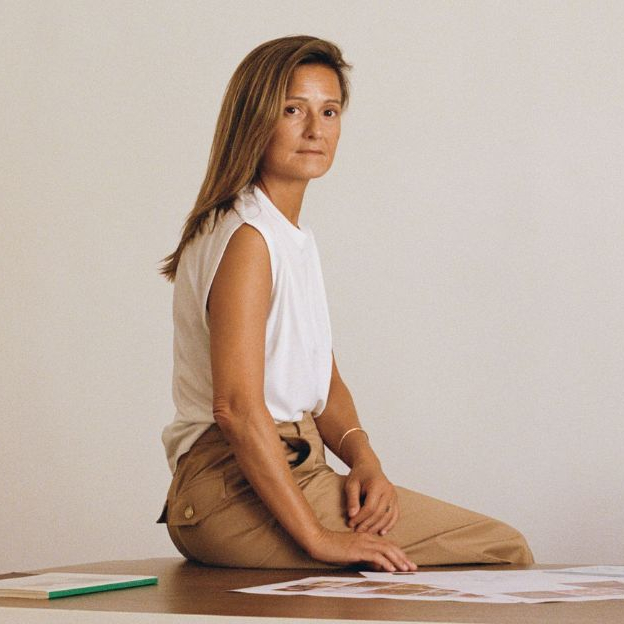
Photo credit: Stéphanie Davilma
Brussels-based architects and friends, Sarah and Nina founded Cru Atelier, a creative laboratory where craft and raw matter become a language. Rooted in their Italo-Moroccan and artistic heritages, they explore the aesthetic and ecological potential of bio-sourced materials – raw earth, lime, hemp, plant fibers – to imagine contemporary forms that are both sensitive and enduring.
Winners of the 3rd edition of the Sessùn Craft Prize with L’Ombre des falaises, la brise de la mer, they present an organic and poetic installation, inspired by Mediterranean landscapes and resonating with the brand’s values – to be discovered at Galeries Lafayette Haussmann in Paris from September 3rd.


Could you tell us about your backgrounds and how your paths first crossed?
Sarah: I come from a dual Italo-Moroccan culture. I grew up surrounded by Moroccan craft – colors, textures, ancestral know-how – while on the Italian side, I was immersed in a culture of sunshine, traditions, and a certain art of living.
Nina: My grandmothers passed on their sensitivity to art and drawing to me at a very young age. I then studied in various art schools before joining Sarah at Saint-Luc, in architecture.
We met at the Faculty of Architecture in Brussels, where we became friends.
How did Cru Atelier come to life, and in what way does the project extend your personal and professional paths and values?
Cru was born organically, alongside our professional journeys. While we were practicing as architects, each of us was already exploring parallel paths.
Nina had set up a workshop reusing wood and metal, working on urban installations, scenography and set design. Sarah was discovering bio-sourced materials through the renovation of her apartment, experimenting with artisanal techniques. Quite naturally, we wanted to create together, combining our skills. It began with objects – a stool – and quickly grew into a deeper desire: to explore craft and matter as language, to move beyond the object, and to create forms that tell stories.

You work with bio-sourced materials that are often overlooked. How do you pass on these ancestral skills, and what role do they play in today’s design and architectural practices?
To transmit is to keep alive the gestures that move us, the crafts and the people who shared their knowledge with us. It also means keeping these traditions alive through storytelling.
We explore bio-sourced materials such as raw earth, lime, hemp, plant fibers, along with techniques often forgotten or set aside in favor of materials seen as symbols of modernity, such as concrete or petrochemical derivatives.
Yet these natural materials are rich and full of possibilities. They resonate with current concerns: they are local, sustainable, healthy, and possess surprising acoustic and hygrometric qualities. And often, their qualities are sensorial.
Through our projects, we share these ancestral practices, inviting experimentation and showing that they can be reinvented in contemporary forms.
In today’s design and architecture, they offer a sensitive, inspiring alternative, while re-establishing a more human connection to time and material.


In your view, what place can – or should – natural materials occupy in contemporary design?
They should hold a central place, but they are still too often assessed through the lens of industrial materials – like plastic or concrete – which makes little sense.
Materials such as earth or lime-hemp breathe, evolve, transform. They can return to the soil without polluting. They foster a different relationship to consumption: slower, more thoughtful, more circular. They can also be repaired or transformed without generating waste – a crucial issue today, given that, according to the European Environment Agency (EEA), construction and demolition waste accounts for just over a third of all waste generated in the EU.
We therefore need to deconstruct the way we assess a material’s performance, and reconnect with a holistic view of its environmental impact.
You won the 3rd edition of the Sessùn Craft Prize with L’Ombre des falaises, la brise de la mer. Could you tell us more about this project?
This project is a kind of materialized narrative. It speaks of territory, of matter, of gestures.
It is a troglodytic installation, conceived as an organic refuge, inspired by Mediterranean cliffs. We worked with local resources such as lime, hemp, wood and straw – simple materials, yet rich in expressive and ecological potential.
The project is visually complex but intentionally simple in its construction. It draws inspiration from natural forms, the rhythm of the waves, and vernacular architecture.

What was the creative process behind the installation, from the initial idea to its realization?
The choice of materials came quite naturally. Lime-hemp echoed both the textile world – a nod to Sessùn – and our respective practices.
We envisioned an organic, fluid layout, evoking Southern landscapes.
Much time was dedicated to testing in the workshop: finding the right texture, the right mix, the right adhesion… The aim was to make the application intuitive and accessible.
We then guided a team (notably Batik and Sessùn) in applying the coatings, in a collaborative and educational approach. Every gesture mattered. It was a moment of transmission as much as of making.


How do you view Sessùn and the Sessùn Craft Prize initiative?
It has been an immensely enriching experience. It gave us the chance to meet other artisans, to exchange and share, notably with Batik.
Our exchanges with the Sessùn teams were very meaningful: we felt a genuine openness and curiosity towards craft and alternative practices.
The Craft Prize is a wonderful opportunity and a fantastic initiative for young architects and designers. It can be intimidating to approach brands to present one’s work; legitimacy is not easy to find, especially with so many talented designers out there. Moreover, Sessùn shares our ethical values and creative universe, so we are deeply grateful to have been awarded this prize.