Photo credit : Floriane Retaux
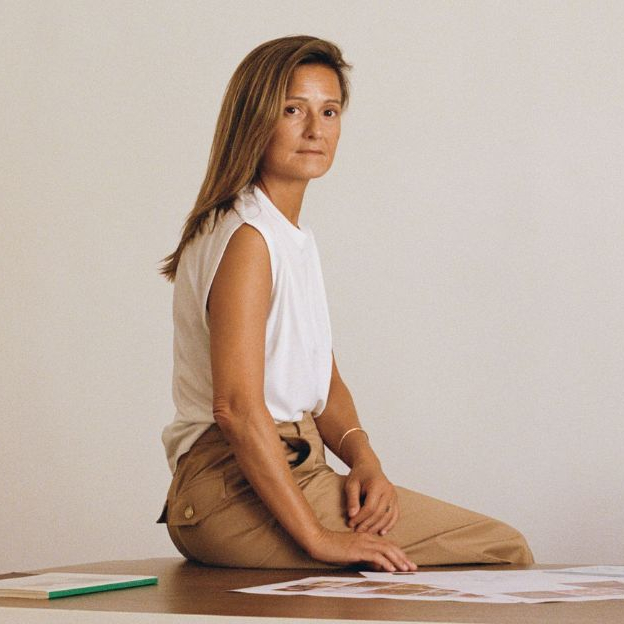
From studying at Sorbonne University to training at ENSCI – Les Ateliers, Margot Graziani has built a body of textile works guided by colour and texture. Inspired by nature, she creates vibrant compositions in which weaving becomes a language in its own right. Her work with Sessùn on the Ezia lamp builds on this exploration: she treats the lampshade as a textile surface, experimenting with colours and free-form shapes, like with a woven canvas. Light then reveals the rich intricacy and sensitivity of her work.
In this interview, we speak with an artist for whom everything begins with colour and whose woven pieces capture fragments of nature and emotion.


Could you tell us about your background and what led you to choose textiles as your artistic medium?
I began studying towards a joint-honours degree in literature and languages at Sorbonne.
But little by little, my study desk became home to all sorts of fabric scraps that I’d picked up here and there. I was fascinated by the structure of the textiles. I needed to understand how the fabrics were made, and that gave me ideas. Around that time, I realised I wanted to make a career out of it. So I started my studies from scratch with an art foundation programme in Paris, followed by a Master’s degree in textile design at ENSCI – Les Ateliers.
During my four years at ENSCI, I mastered the traditional technique of weaving on a handloom. Threadwork and weaving have become my language, the way I express myself: I find a certain freedom in the physicality of the materials and in combining the colours.
Your workshop is located near Dieulefit, in Drôme Provençale, and you make your dyes from natural resources. How do this region and the natural surroundings influence your work and your colour palettes?
I’ve always been passionate about colour. The eureka moment for using colours made from natural resources came when I moved to Arles and began working with the textile research lab at Atelier Luma. Whilst learning about traditional plant-based dyeing techniques, I also carried out research into colours derived from Mediterranean dye plants. Using plants that I'd gathered myself or sourced from local growers, I created colours and colour palettes drawn directly from the landscape. This same process continues to guide me in my new home in Drôme. So there's a close connection between my palettes and the landscape that surrounds me.

Is there a particular memory or place that inspires your work with textiles?
Yes, nature itself! Nature allows me to connect with very straightforward emotions and a sense of universal beauty. Living in Provence means I spend a lot of time outdoors, so I find myself looking at the shape of the hills, the light in winter, the sunsets, and how the vegetation changes season after season. I like photographing flowers and leaves that catch my eye with their colours or shapes, and I sometimes use these photographs as a starting point for my woven pieces. My natural surroundings, together with childhood memories, influence my day-to-day work.


Could you describe your creative process, from making the dyes to creating your woven pieces?
Colour is always the starting point of my creative process. I often have a specific colour in mind, or colour palette, which I first explore using pastels or pencils. This is the freehand sketching stage. I then reproduce this colour palette with plants and plant extracts by preparing my own concentrated mixtures, known as "plant inks", which contain the fixative, alum. This exploration, which I carry out in my colour lab, can take some time. Then, the stage I enjoy most, is comparing these ink colours with threads on my loom. These can be threads that I've dyed myself or pre-dyed French linen threads. On my loom, painting with inks and weaving the threads gradually reveal forms that are more or less abstract and always very colourful. This interplay of colours creates a particularly vibrant energy.
You've designed a lampshade for the Ezia lamp by Sessùn. Could you tell us about this collaboration and how you incorporated your textile approach into
this design project?
I really love the world of Sessùn. The richness of the materials, colours and textures, as well as the celebration of craftsmanship and the close bonds with art and artists’ studios. I saw a link between Sessùn and my own work: the range of colours, the artists they work with. It was a no-brainer to me; I wanted to continue my work exploring colour in a very intuitive and spontaneous way, like painters with their palettes. I came up with two colour palettes and designed two free-form visuals inspired by this imagery. The Ezia lamp offers great freedom for creativity thanks to its square, elongated shape, so I just treated it like one of my woven canvases.

What projects or areas of exploration are you currently passionate about? Where would you like to take your work as an artist in the coming years?
At the moment, I’m experimenting with different thicknesses and qualities of thread to enhance the texture and physicality of my pieces. I use a variety of raw materials and have no qualms about reworking my woven pieces once they're off the loom, which is all the more fascinating as I'm currently carrying out research into my working tool, the loom. What I have in mind is a new bespoke tool that would make weaving and painting even freer, allowing me to explore new, less restricted dimensions. This is a direction I feel strongly about for the years to come: creating large woven pieces, as colourful as ever, that make a bold statement in any space.
Can you tell us about a surprise you encountered during your process that ultimately led to a new creative direction?
In my studio, I work in increasingly free and intuitive ways, which inevitably throws up some
surprises! I really enjoy playing with floating warp and weft threads to highlight the very essence of weaving as a technique, i.e. threads that cross over to create a surface. Lately, I’ve been experimenting with these tensions between the warp and weft, which create unexpected textures. This is a new avenue of research I’m currently exploring, allowing me to add depth or a three-dimensional quality to certain pieces. Breaking away from the very flat, grid-like surface of the weave is really exciting!


What sort of things would we find in your studio at the moment: objects, tools, everyday sources of inspiration?
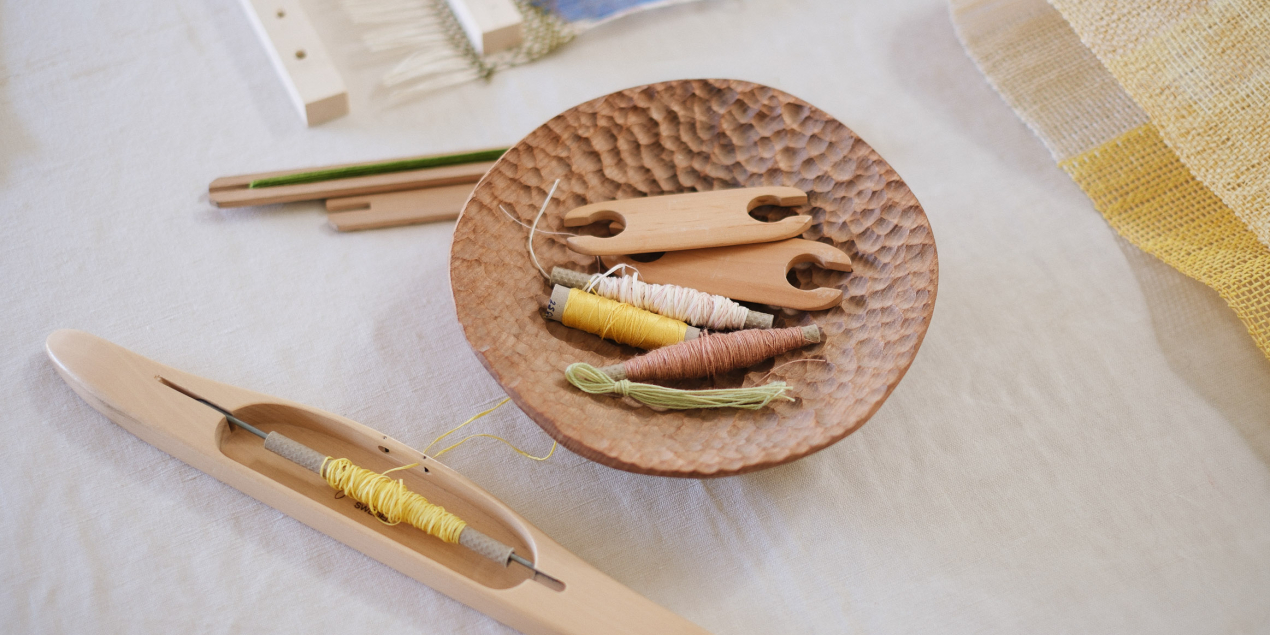
There's an old wooden loom, surrounded by weaving tools like shuttles and spools of natural thread (linen, paper, hemp, wool). The walls are often covered with ongoing projects, areas of research, fabric samples and, most of all, drawings. I've also made space for my "colour lab", where I prepare my inks. Here, I keep dried plants, a set of scales, pigments, containers and brushes. And, of course, a number of art books that inspire by day-to-day work. A book by Etel Adnan or a guide to natural colours is always close to hand.