Photo credits : Stéphanie Davilma
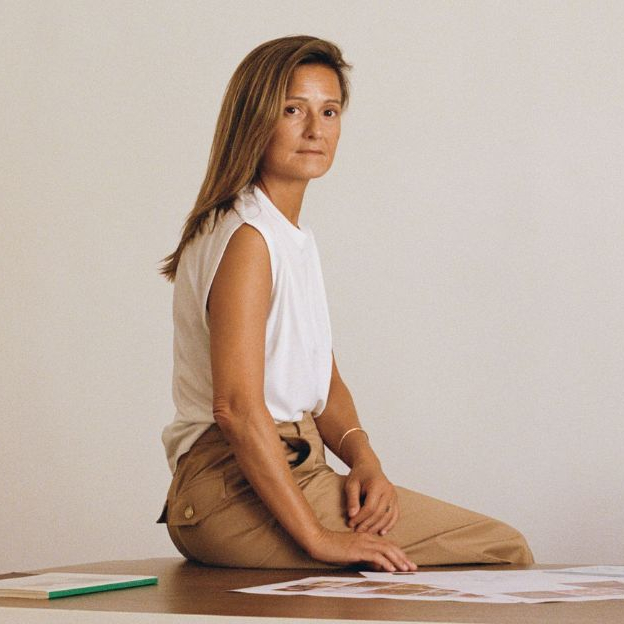
Having settled in the Ardèche after studying at La Cambre in Brussels, Livia Spinga has developed a ceramic practice in which the material retains the traces of the artist’s touch. Inspired by the landscapes she lives in and the art of pottery, she explores the principles of assembly, decoration and transformation.
For the opening of the first Sessùn boutique in Milan, she designed a monumental ceramic chandelier composed of suspended modular elements, building on her exploration of light, materials and the contrasts between weight and lightness.
We met with her to discuss her career, her experiments with local materials, and the role of the unexpected in her creative process.


You graduated from La Cambre in Brussels before moving to the Ardèche. Could you tell us about your career path and the key moments that have shaped your artistic practice today?
I grew up in the Paris region before studying applied arts and sculpture in Rome, Paris and Brussels, where I completed my studies with a master’s degree in ceramics at La Cambre with a specialisation in contemporary art. After finishing school, I set up my studio in the Ardèche. I have also become a part-time teacher of design and crafts. I could never abandon the workshop, but this balance has allowed me to continue my training and research. Moving to the Ardèche has broadened my perspective on ceramics. It was there that I discovered a whole culture of pottery through encounters with people, visits to various places and wood-fired kilns. The geological diversity of the region has also enabled me to develop a different approach to materials. All these experiences have shaped my practice and gradually led me toward creating decorative and sculptural objects.
What are your main sources of inspiration – in art, craftsmanship or your daily life in the Ardèche?
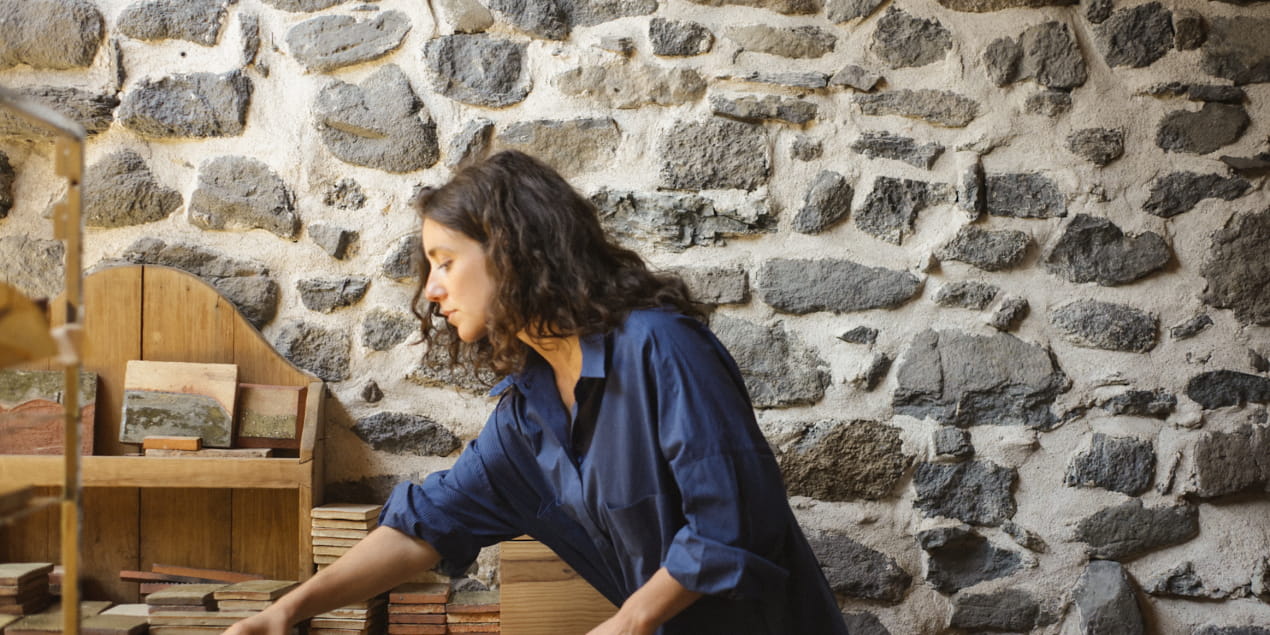
My sources of inspiration are many and varied, and, in fact, I like to think of my pieces as collages. I create my ceramics by blending the language of pottery with forms drawn from the decorative arts, vernacular architecture and my everyday surroundings. I have always seen objects as puzzles to be solved. In my work, I like to give clues as to how they were made. I love shapes that fit together and adapt to one another, from beads to bricks, and everything in between – stones and pebbles – these elements have been built up in our landscapes, our jewellery and our architecture since the dawn of time. I am fascinated by the richness of their associations and their practical and decorative qualities. The construction and joints, left exposed, become decorative features.

You work with soil, ash and minerals gathered from the area around your studio. How do you choose these materials?
My choices came about gradually; I felt things out and gave it a go. I was fortunate enough to work with a geologist, Maryse Aymes, and to meet ceramicists who are sensitive to these issues. The Ardèche is a particularly complex region geologically, which gives me access to a wide variety of minerals. I also have access to a jar grinder at a fablab in Ardèche called Polinno. I am not engaged in a systematic or deliberate process of collecting. I sometimes incorporate a new material into my research and explore the combinations it can produce. Over time, I have mainly developed a simple approach that suits my own working pace and the day-to-day running of the workshop.


You place ‘hesitation, imperfection and messiness’ at the heart of your work. How do these concepts actually help you in your creative process?
As in any artistic practice, the final work is the result of a series of choices: to reveal or conceal, to smooth over or leave things as they are, to clarify or preserve the trace of a gesture. I try to retain an element of hesitation and imperfection in what I present, as a way of countering my own automatic responses. In this way, I avoid clinging to any preconceived notions I might have had about my subject. I like to let my work take me by surprise a little, so I can break free from certain limiting ideas that we tend to internalise.
Sessùn has opened its first shop in Italy – in Milan – and you created some ceramic pieces for it. How did this collaboration and dialogue with the brand’s artistic universe come about?
I was approached by the team at Sessùn. During our first exchange, we talked about ceramics, but also about their wish to entrust me with a project on a new scale, offering considerable freedom in terms of design and production. They then put me in touch with Cobalto Studio, who were responsible for the design and art direction of the project. Their initial proposal for the lighting and door handles was perfectly in tune with my work. I then produced several sketches, and very quickly the project began to take shape. Over the course of a few weeks, I went over all the technical aspects with the architects. I also coordinated the construction of the fixture with Atelier Feuz, a metalworker with whom I had collaborated previously, who carried out the work with great care and sensitivity. Then came the installation in Milan, which I did with the help of local tradespeople – a new experience for me, but one that ultimately went very smoothly. I really enjoyed this project, particularly because of the quality of the discussions and the trust placed in me by colleagues who were so responsive and have such high standards.

How did you go about creating this ceramic chandelier? What was your intention as far as light, colour and material?
It all started with a proposal from Sessùn and Cobalto Studio. They wanted to take my work in lighting with modular ceramic elements to a larger scale. Cobalto Studio outlined a proposal that I liked. From there, I set to work, first spending several weeks on the design and planning stage, and then moving on to the workshop. For the overall shape of the chandelier, we took a traditional object as our starting point: by attaching the rows of tiles around the same circumference and marking out four suspension points, the chandelier became a simple skylight. I’ve been using this tile template ever since I was a student. The shape is inspired by a childhood memory: a floor of overfired bricks in a place where I used to live. I would wander across the floor, playing with the lines. I’ve retained the image and a sense of it, which I’ve reinterpreted in my work. My work is characterised by the use of chamotte clay worked in thick layers. I like to transform these heavy, raw objects into something precious, particularly through the use of glazes in naturalistic shades and the creation of textures and marks. A touch of sophistication is added with the screws, each one forged by Atelier Feuz. What's more, in this project, the weight clashes with the visual lightness of the suspended tiles.